
You Have Leaders, But Do You Have a Leadership Culture?
Ask five of your leaders to describe how leadership works at your company.
Go ahead. Try it this week.
I'd bet good money you'll get five different answers. Maybe wildly different ones.
That's not a small thing. Those five answers are telling you something about your organization that most CEOs miss: you have leaders, but you don't have a leadership culture. And the gap between those two things is costing you more than you think.
It's the same gap that explains why so much leadership development falls flat. You can coach your leaders. You can send them to training. You can build beautiful development plans for your high-potentials. None of it adds up to organizational change when the underlying culture is undefined.
When I ask CEOs to describe their leadership culture, most can't. They'll point to company values. They'll mention the mission statement. They'll reference a leadership competency model someone built five years ago.
But the actual culture? The shared way leaders lead day in and day out? That tends to live in everyone's head a little differently.
Which is exactly the problem. You can't strengthen what you can't name.
What Leadership Culture Actually Is
Leadership culture is the shared pattern of how your leaders lead. It answers a simple question: How do we lead here, as opposed to anywhere else in the world?
For something to qualify as a leadership culture, three things have to be true:
It's shared. All leaders embrace it, not just a few.
It's modeled. It's visible in behavior, not just spoken about in meetings.
It's named. It's defined, taught, and owned by the people in your organization. Someone new could learn it.
Think of your leadership culture as your leadership operating system. The shared assumptions, standards, and behaviors that leaders from the front line to the C-suite live out every day.
Most organizations don't have this. They have leadership individuals. The two are not the same thing.
The Leadership Culture Coherence Triangle
For your leadership culture to actually hold, it has to operate across three distinct dimensions. I call this the Leadership Culture Coherence Triangle.
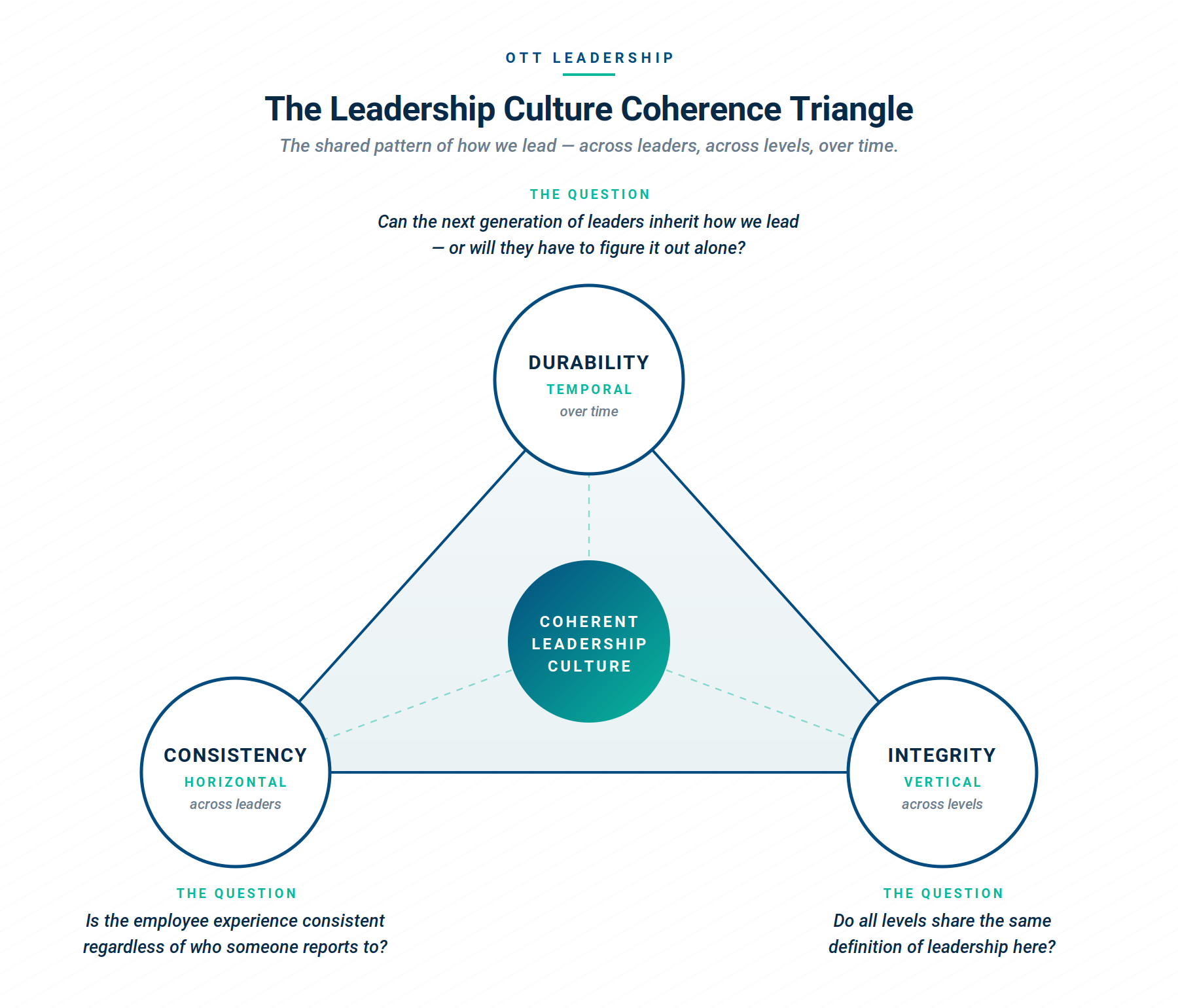
1. Horizontal: Across Leaders → Consistency
The question: Is the employee experience consistent regardless of which leader someone reports to?
We've all been in that situation. You interact with one leader who's warm and approachable. Then you go to the next leader who's cold and distant. It creates a confusing, exhausting experience for employees.
The key word here is consistency. Can an employee show up to work knowing what they'll experience from their leaders, no matter what's happening?
When the answer is no, what you have isn't a leadership culture. It's a collection of personalities.
2. Vertical: Across Levels → Integrity
The question: Do executives, directors, managers, and supervisors share the same definition of leadership here?
This is about integrity. Leadership has to hold at every level. When the leadership message you're trying to deliver gets diluted as it travels down the line, you've lost the integrity of your culture.
Frontline leaders end up making it up as they go. Mid-managers improvise. The C-suite assumes the culture is strong because they feel it at their level. It isn't.
3. Temporal: Across Time → Durability
The question: Can the next generation of leaders inherit how we lead here, or will they have to figure it out alone?
This dimension is the multiplier.
You can build a leadership culture that's strong horizontally and vertically. The real test is whether it lasts. A leadership culture that depends on whoever's in the corner office right now isn't a culture. It's a personality.
This is about durability. Your leadership culture has to survive a leadership transition. Otherwise it walks out the door when key people retire.
Most cultures fail this test. They look strong while a charismatic CEO is running the show, then collapse the moment someone new takes over.
What Full Coherence Looks Like
When your leadership culture is coherent across all three dimensions, something powerful happens: it holds up without you holding it up.
It's not one person doing the work. It's not a great CEO carrying the weight. You've built a system that carries throughout the organization and stands the test of time.
That's what most leadership development programs are missing. They're building individuals. They're not building a culture. Which is why you can spend years investing in your leaders and still feel like nothing's actually changing at the organizational level.
Your Starting Point
Before you invest another dollar in leadership development, sit with this question:
If I asked five of my leaders to describe how we lead here, would I get the same answer?
Five different answers means you don't have a leadership culture problem you can solve with more training. You have a clarity problem. And clarity comes before culture.
That's worth paying attention to.
Ready to Build Leadership Culture Coherence?
If naming and building your leadership culture is what's on your plate this year, contact me to discuss your situation. We can map out where the coherence is breaking down across your leadership team and what to do about it.
Want more leadership insights like this?
Join other mission-driven leaders who get Steve's weekly newsletter with practical strategies, real client stories, and the frameworks that actually work, and never miss the latest thinking on leadership transformation.