
From task-focused to transformational: The three leadership stages that build real confidence
How have you noticed yourself as a leader in the past few weeks?
Are you recognizing when the fight to feel confident creeps into how you show up?
Has it changed how you communicate? How you relate to employees? How you make decisions? How you deal with conflict?
The fight to feel confident as a leader can feel all-consuming.
It doesn't have to be.
Last week, I discussed the negative impact that leaders stuck in Stage 1 and 2 have on employee engagement and organizational success.
I said that the fight to prove yourself traps you in a vicious cycle that's hard to escape.
The Solution: Think Less About Yourself
The moment you make an impact on someone's life is the moment you'll feel more confident.
Why?
Because that's when you realize that leadership isn't about you.
Yes, you carry the title, authority, and burden.
But you are only successful as a leader if your team is successful.
What good would it be to run out ahead of your team, only to realize no one is following?
The goal of a transformational leader is to help your team win.
Full stop.
This is the trajectory of leaders who move from Stage 3 to Stage 5.
They begin to realize that they don't HAVE to feel confident, as long as they are making a positive impact on those around them.
The irony?
This mentality often leads to an increase in leadership confidence.
Let's explore Stages 3 through 5 of the Leadership Confidence Ladder to see how these leaders build confidence by serving those around them.
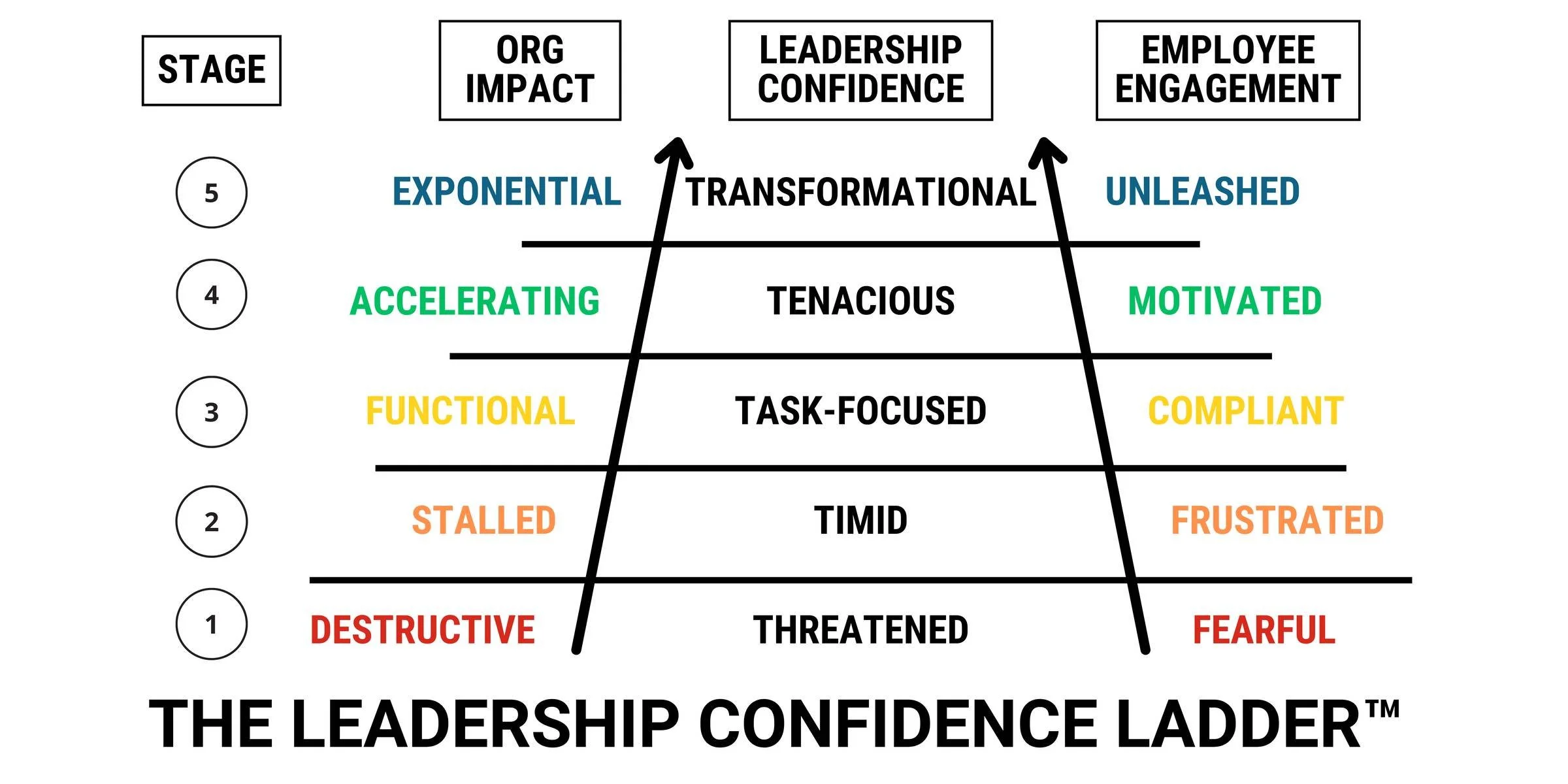
Stage 3: Task-Focused
Organizational Impact: Functional | Employee Engagement: Compliant
The upward swing begins here. Leaders want to be successful, so they focus on areas where they can win—the same place that earned them the promotion: executing tasks flawlessly. They lead like supercharged individual contributors.
What it looks like:
Lock into personal to-do lists instead of empowering others
Build surface-level relationships focused on task completion
Get stuck in operational weeds that their team should handle
Choose easily achievable goals over critical, transformational objectives
The employee experience:
Team members operate with compliance but lack inspiration. They never feel like true owners of their work and constantly wait for the leader to assign the next set of tasks.
The cost:
The organization functions adequately but never approaches its potential. Without employee ownership, innovation and proactive problem-solving are minimal.
Stage 4: Tenacious
Organizational Impact: Accelerating | Employee Engagement: Motivated
The breakthrough moment. Leaders discover that results aren't measured by personal accomplishment but by organizational impact. This revelation lights a fire—they want to maximize their impact, so they reorganize their entire approach.
What it looks like:
Start every decision with "What's the impact?"
Communicate with clarity and conviction about direction and expectations
Provide regular, specific feedback to help others improve
Focus exclusively on strategic, high-impact work that only they can do
The employee experience:
Team members are energized by clear direction and strong leadership. They understand priorities, feel supported in their growth, and are motivated to perform at higher levels.
The breakthrough:
This determined energy becomes infectious, creating momentum that's felt across all areas of the organization. Results accelerate because everyone is pulling in the same direction.
Stage 5: Transformational
Organizational Impact: Exponential | Employee Engagement: Unleashed
The pinnacle of leadership confidence. Leaders recognize that their success is entirely dependent on others' success. They shift from leading tasks to developing people, understanding that unleashed employees create exponential organizational results.
What it looks like:
Focus exclusively on people development rather than task management
Create lasting change in their teams through intentional coaching
View feedback as a gift and accountability as the kindest thing they can offer
Trust that when employees succeed, everyone wins
The employee experience:
Team members don't just feel motivated—they're unleashed to reach their full potential. They become complete owners of their work and outcomes, taking initiative and driving innovation.
The result:
The compounding effect of fully unleashed employees led by transformational leaders allows organizations to reach heights they never thought possible. Success becomes sustainable and self-reinforcing.
Now What?
Stage 5 is the ultimate expression of leadership confidence.
It's the full realization that your ultimate organizational success is on the shoulders of each and every person on your team.
And you have the power and authority to help everyone win.
The big question: how will you use that power and authority?
Will you use it to suck up accolades and success for yourself?
Or will you use it to serve and empower your team?
Take Action With Your Leadership Team
The first step toward becoming a Stage 5 Transformational Leader is to talk about it as a leadership team.
Here's my challenge to you: set aside a leadership team meeting to talk about the Leadership Confidence Ladder.
Discussion Questions:
Where do you think you fall on the Leadership Confidence Ladder? Why?
What stage are we in as a leadership team?
What would we need to change to move up one stage?
What can we commit to doing together as a leadership team?
Ready to Transform Your Leadership?
If you take on this challenge, I'd love to hear how the conversation goes. Contact me to share the most important insights that came out of your leadership team discussion, or to explore how to accelerate your journey up the Leadership Confidence Ladder.
Want more leadership insights like this?
Join other mission-driven leaders who get Steve's weekly newsletter with practical strategies, real client stories, and the frameworks that actually work, and never miss the latest thinking on leadership transformation.