
When leadership confidence fails: The two stages that destroy organizations
Last week, I introduced the idea of leadership confidence and the Leadership Confidence Ladder.
Leadership confidence isn't how you feel; it's how you show up. It's revealed through your relationships, communication, and responses to challenges when people are watching.
The ultimate measure? The impact you make on your organization and employees.
Here's what I tell leaders: you'll never actually feel as confident as you think you should.
Chasing the feeling of leadership confidence is as foolish as chasing the wind.
You can sense it, but never fully grasp it.
Instead, if you want to feel confident, focus on helping others experience success.
The moment you make an impact on someone's life is the moment you'll feel more confident. Why?
Because that's when you realize that leadership isn't about you.
But what happens when leaders don't feel confident? Or they try to chase down the feeling of confidence?
This week, I want to explore Stages 1 and 2 of the Leadership Confidence Ladder and how leaders in these stages can have a significantly negative impact on your organization.
How Low Confidence Impacts Leadership
When employees become leaders, they begin to feel a spotlight shining on them that prompts all sorts of questions:
Will the team think I'm qualified to be a leader?
Will my team be successful?
How in the world do I do this?
What if I fail and it's out of my hands?
To a degree, people ARE watching you, but not because they want to see if you'll fail: it's because you can help them succeed.
However, leaders stuck in Stage 1 or 2 on the Leadership Confidence Ladder are so focused inward that they aren't thinking about their team's success.
Instead, they are trying to prove themselves worthy of leading.
As I mentioned last week, the more you try to prove your leadership worth to those around you, the more it undermines your leadership.
This creates a vicious cycle: the more you try to prove yourself, the more it undermines leadership. This erodes confidence, creating a need to prove yourself, which in turn undermines leadership.
The Two Sides of Low-Confidence Leadership
Stages 1 and 2 are two sides of the same low-confidence coin.
When you lack confidence as a leader and try to prove yourself, you are left with two paths: one is to act aggressively, and the other is to act timidly.
Here's how each stage plays out, including what it looks like in real life, how it impacts employee engagement, and the overall impact on your organization:
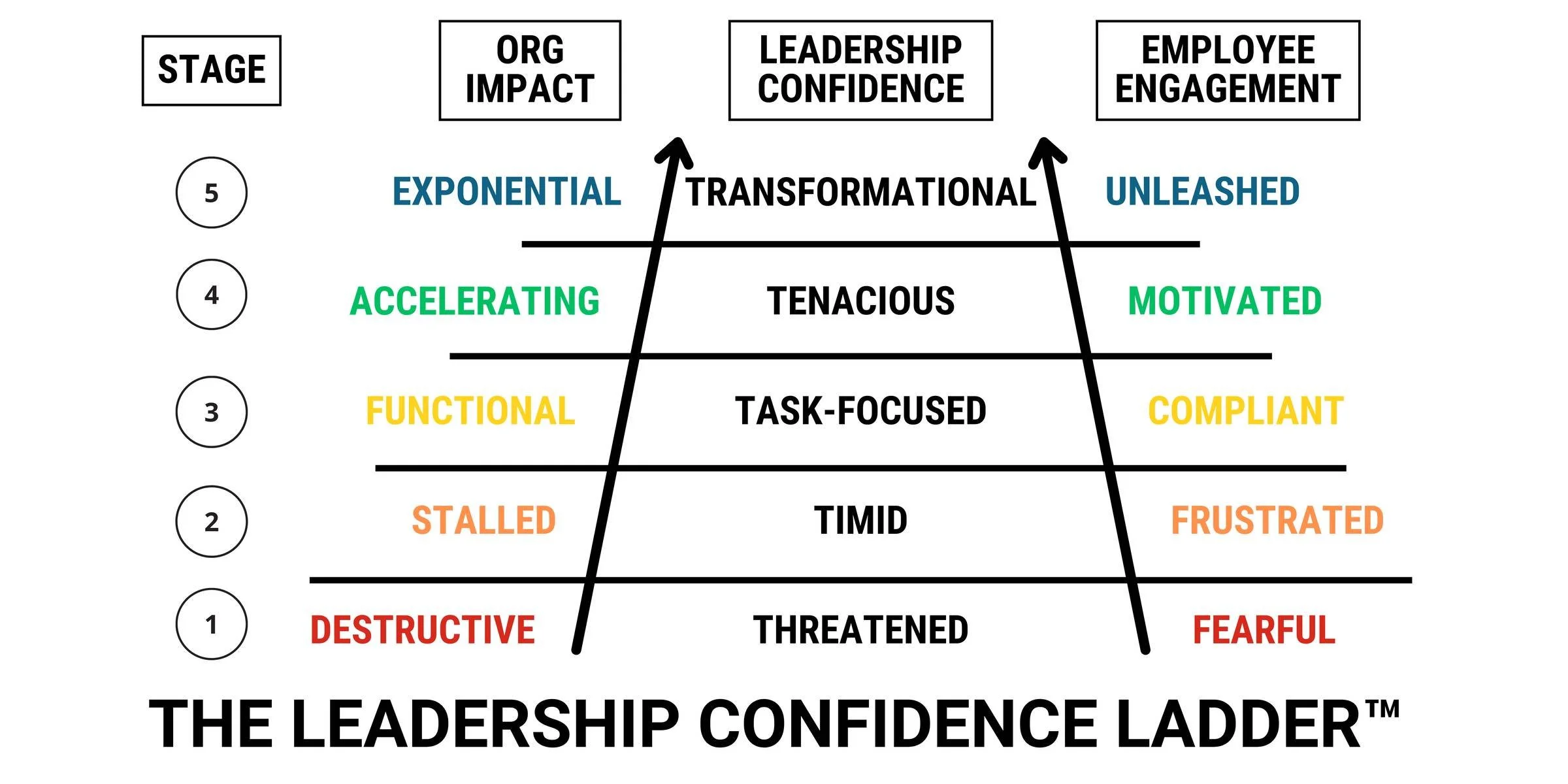
Stage 1: Threatened
Organizational Impact: Destructive | Employee Engagement: Fearful
When leaders feel the least confident, they can feel the most threatened. Since they believe confidence is a leadership requirement, they can't allow others to see their uncertainty. They believe that their worth and value as a leader is displayed via their command and control. So, they overcompensate with aggression.
What it looks like:
Lean into transactional, command-and-control leadership
Resort to yelling, manipulation, or veiled threats
Communicate in ways that leave employees feeling uneasy
Make decisions based on maintaining authority rather than what's best for the organization
The employee experience:
Team members are constantly worried about their job security. They avoid bringing up problems, stop taking initiative, and focus on not making mistakes rather than achieving results.
The cost:
This stage drives away your best people, grinds productivity to a halt, and damages customer relationships. High performers won't tolerate this environment long.
Stage 2: Timid
Organizational Impact: Stalled | Employee Engagement: Frustrated
This is the imposter syndrome stage. Leaders recognize they can't continue the aggressive approach, but they deeply doubt their qualifications. They're concerned that they may not be skilled enough or "leadership-worthy," so they hold back. They assume that by being quiet and unassuming, they can remain invisible as a leader.
What it looks like:
Communicate with vague, non-committal messaging
Avoid making difficult decisions or taking clear positions
Offer tepid feedback (or avoid feedback conversations entirely)
Neglect relationship-building because they feel awkward in the leadership role
The employee experience:
Employees are frustrated and confused. They're unsure where they stand, unclear about priorities, and don't know what's expected of them. They want direction but aren't getting it.
The cost:
Progress stalls across the organization. Everyone stays in a holding pattern while opportunities pass by and problems compound.
The Path Forward: Expose the Secret
Here's the counterintuitive truth: The fastest way to gain confidence is to stop hiding your lack of it.
The longer you or your team maintain the mirage, the longer everyone stays stuck in Stage 1 or 2.
Start the Conversation
Use this framework as a discussion piece with your leadership team:
Are you a Stage 1 or 2 leader? Why?
Are any leaders in our organization currently stuck in Stage 1 or 2? Why?
What can we do to support their move up one stage?
What can we commit to doing together as a leadership team?
Your Next Step
Before engaging your team in this conversation, take a moment for honest self-reflection.
Which stage resonates most with how you currently show up as a leader? Remember, this isn't about judgment—it's about growth.
The reality: 80% of leaders struggle with confidence. You're not alone, and acknowledging your current situation is the first step toward transformation.
Your organization and employees are counting on you to stop hiding the struggle and start climbing the ladder.
Ready to Assess Your Leadership Confidence?
I'd love to hear where you think you currently fall on the ladder. Contact me to discuss your leadership confidence journey and create a development plan that moves you up the ladder.
Want more leadership insights like this?
Join other mission-driven leaders who get Steve's weekly newsletter with practical strategies, real client stories, and the frameworks that actually work, and never miss the latest thinking on leadership transformation.