
The hidden leadership struggle that's costing your organization
I've worked with hundreds of leaders over the last six years, and 80% of them share the same secret struggle. It's not a lack of skill, strategic thinking, or systems understanding.
It's a lack of leadership confidence.
Here's what's fascinating: they're desperate to hide this struggle because they believe confidence is a leadership requirement. So they create a mirage, appearing confident while feeling anything but.
This mirage is what's actually costing organizations.
The more you try to prove your confidence to those around you, the more it damages your leadership.
Here's why:
Why leadership confidence really matters
Leadership confidence isn't how you feel; it's how you show up. It's revealed through your relationships, communication, and responses to challenges when people are watching.
The ultimate measure? The impact you make on your organization and employees.
In my work with leaders over the years, I have found a strong correlation between leadership confidence and employee engagement. When leaders are leading with confidence, employees experience an engagement boost. These leaders aren't trying to prove their confidence: they are focused on serving those around you.
However, when leaders struggle with confidence, engagement tends to drop.
These leaders feel the need to prove their worth, so they focus inward, desperately trying to lead while hiding the fact that they aren't sure how to do so.
The organizational impact
The ripple effects throughout the organization are immediate:
Increased leader stress and decision paralysis
Lower employee engagement and unclear direction
Teams walking on eggshells or feeling frustrated
Strained workplace culture and decreased performance
Leaders have an outsized impact on the success of your organization. As leaders go, so goes your organization.
If you want to improve your organization, start by improving leadership confidence.
The leadership confidence ladder
Through my work, I've identified five distinct stages that every leader moves through on their confidence journey, which I call the Leadership Confidence Ladder. Since leadership confidence is based on the impact made, not just feelings felt, the model illustrates how each stage affects the organization and employee engagement.
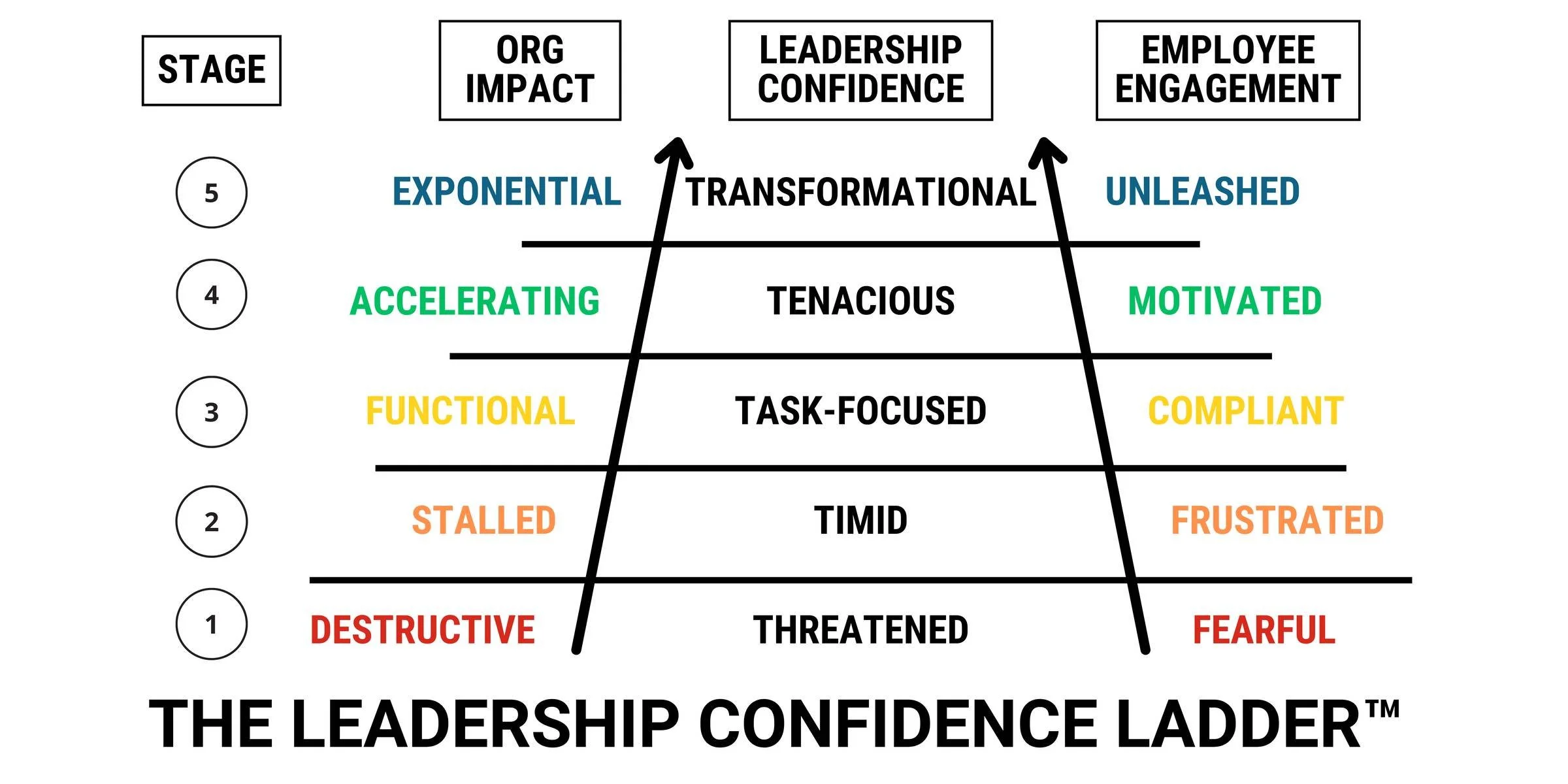
How to read the model: Each stage shows your leadership confidence level in the center, with the organizational impact on the left and employee engagement level on the right. As you move up the ladder, both impact and engagement improve dramatically.
In this series, I will explore each stage in-depth. For today, however, here's a brief explanation of each stage:
Stage 1: Threatened - When leaders feel the least confident, they often overcompensate with aggressive, command-and-control tactics.
Stage 2: Timid - The imposter syndrome stage, where leaders doubt their qualifications and communicate with vague, non-committal messaging.
Stage 3: Task-Focused - Leaders focus on areas where they can win, executing tasks flawlessly like supercharged individual contributors.
Stage 4: Tenacious - The breakthrough moment when leaders discover that results are measured by organizational impact, not personal accomplishment.
Stage 5: Transformational - Leaders recognize their success depends entirely on others' success and focus on developing people rather than managing tasks.
Each stage creates dramatically different organizational outcomes and employee experiences. The difference between a Threatened leader and a Transformational one isn't just noticeable; it's the difference between destructive impact and exponential growth.
What's coming next
In upcoming posts, I'll take you deep into each stage of the Leadership Confidence Ladder.
You'll discover:
The specific behaviors and mindsets that define each stage
How employees experience leadership at each level
What it costs your organization to stay stuck
Exactly what it takes to climb to the next stage
The breakthrough moments that create lasting transformation
The counterintuitive truth
Here's what I want you to know before we dive in: The fastest way to gain confidence is to stop hiding your lack of it.
The longer you maintain the mirage, the longer you stay stuck at lower stages. The leaders who make the biggest transformations are the ones willing to acknowledge where they really are.
Your starting point
Before we explore Stage 1 in the next post, take a moment for honest self-reflection. Think about your last challenging leadership moment, the kind where you felt the pressure and everyone was watching.
How did you show up? Did you feel threatened? Timid? Focused on getting tasks done?
This isn't about judgment, it's about growth.
80% of leaders struggle with confidence. You're not alone, and acknowledging where you are is the first step toward transformation.
Your organization and employees are counting on you to stop hiding the struggle and start climbing the ladder.
Ready to assess where you fall?
Want to discuss which stage resonates most with how you currently show up as a leader? Contact me to continue the conversation about your leadership confidence journey.
Want more leadership insights like this?
Join other mission-driven leaders who get Steve's weekly newsletter with practical strategies, real client stories, and the frameworks that actually work, and never miss the latest thinking on leadership transformation.